Da Inner Sound, Y'all
3 Feet High and Rising by De La Soul - I came to this album backwards. Through De La Soul Is Dead, back to the beginning. I didn't know any of the songs. And then I pressed play. Here's the story behind the cover that changed hip hop.


I came to 3 Feet High and Rising backwards. My first De La Soul album was De La Soul Is Dead; the darker, more confrontational second album. After listening to that, I needed to find the debut. I didn't know any of the songs. I didn't know what to expect.
And then I played it. And understood immediately why this is one of the great albums. Every song remarkable. The chill. The warmth. The wit. The completely distinctive world that De La Soul had built and invited you inside.
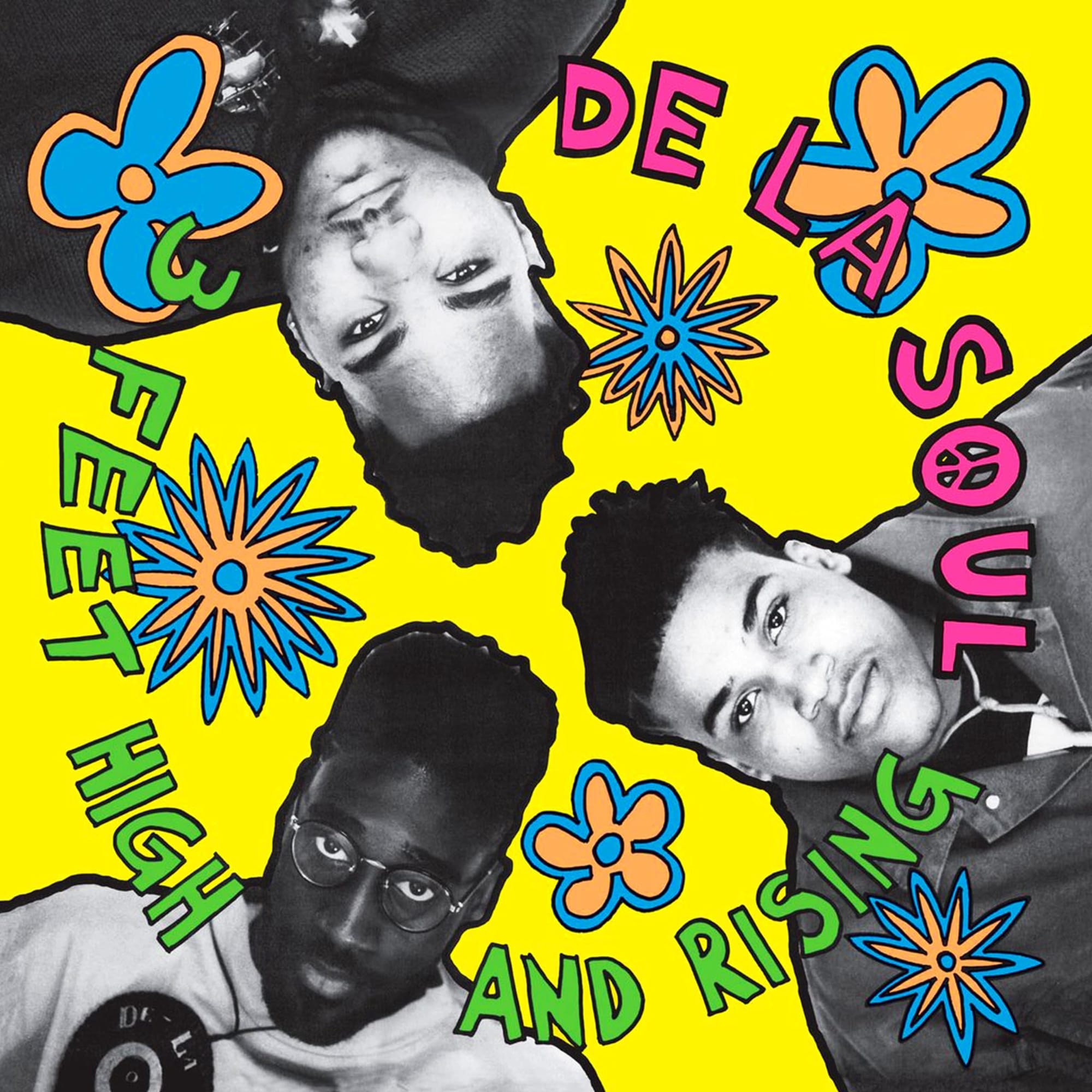
But before I heard any of it, I saw the cover. Three men lying on their backs, heads forming a triangle, looking up at a camera held by someone hanging off a step ladder. Bright hand drawn daisies layered over a black and white photograph. Colours that shouldn't work together somehow working perfectly.
I really want one of those daisies tattooed somewhere on my arm.
Album Anatomy
| Album | 3 Feet High and Rising |
| Artist | De La Soul |
| Genre | Hip-Hop |
| Released | 6 February 1989 |
| Label | Tommy Boy Records |
| On the cover | A black-and-white portrait of the trio overlaid with brightly coloured, hand-drawn Day-Glo flowers and lettering |
| Design | Grey Organisation (Toby Mott) |
| Decade | 1980s |
| Buy | Amazon / eBay |
Minnie Mouse and a Nightgown
In 1989, hip-hop cover art was dominated by gold chains, boomboxes, and street-centric posing (think Eric B. & Rakim or N.W.A). Designer Toby Mott and photographer Gus Coral flipped that entirely with fluorescent day-glo pink and yellow, hand-drawn daisies, and peace-sign doodles.
But, before we talk about the cover we need to talk about the daisies. Because the daisies are everything and they started somewhere nobody expected.
According to Posdnous, the group coined the term "the daisy age" after they noticed a nightgown in a store that had a picture of Minnie Mouse holding a daisy on it.
A Minnie Mouse nightgown. In a shop window. That is where the Daisy Age began.
D.A.I.S.Y. stood for Da Inner Sound Y'all. The Daisy Age referenced and paid homage to the flower children of the 1960s who pushed for social change while re-interpreting the ideas of social awareness and activism for a new age.
Three young men from Long Island; Posdnous, Trugoy the Dove, and P.A. Pacemaster Mase saw a Minnie Mouse nightgown, thought of daisies, built a philosophy around them, named that philosophy with an acronym, and put it on one of the most important debut albums in hip hop history.
The cover was always going to have daisies on it. That was never in question. The question was how.
The Grey Organisation and the Step Ladder
The answer came from an unlikely source.
The album's artwork was designed by Toby Mott of the British art collective the Grey Organisation, who had relocated to New York City after their attack on Cork Street's art galleries and subsequent prosecution.
Let's pause on that for a moment. The people who designed the 3 Feet High and Rising cover had recently been prosecuted for attacking London's most prestigious gallery district and had fled to New York. They were living in a loft on Grand and Centre Street in lower Manhattan, where (in Mott's own words) the rent was cheap but there were rats on the staircase.
Mott heard De La Soul's debut twelve inch promo at the Tommy Boy Records office and knew immediately. In his own words: "I put the record on the turntable and have to play it at full volume; it's so low fi, it sounds dusted. This is not Bring the Noise Hip Hop but something completely fresh; altogether more melodic and playful."
The collaboration was immediate. De La Soul visited the Grey Organisation's loft and the cover was conceived and shot in a single session. De La Soul lay down on the floor facing up, their heads making a triangle. Mott photographed them whilst hanging precariously off a step ladder, one idea being that the cover would not have a right way up.
No right way up. A cover that could be rotated and still work. For a vinyl sleeve, in an era before CDs dominated, that was a radical design concept.
Mott layered the brightly coloured hand drawn flower designs made with Posca paint pens on acetate over the black and white photographic portrait print, which was rostrum camera copied. This was well before the time of Apple Macs and scanning.
Hand drawn. Posca paint pens. Acetate overlays. Rostrum camera. No computers. Everything physical, everything made by hand, in a loft with rats on the staircase.
Not Hippies. Not Even Close.
The media perceived De La to be the hippies of hip hop, a notion derived from the fact that they wore bright tie-dyed clothes, substituted leather medallions for gold chains, incorporated a peace symbol into their cover art, and made repeated references to daisies throughout the album.
The group's response was unambiguous. "We can have a psychedelic sound in some of our cuts, but we are not psychedelic rappers and we are not hippies. We are not hippies."
They were not hippies. They were three young men from Long Island who had looked at hip hop in 1989; the gold chains, the leather, the aggression, the posturing, and decided to do something completely different. Not as a reaction to it. Not as a critique of it. Simply because it wasn't who they were.
De La Soul never asked to be the saviours of hip hop, much less to answer for all the supposed pathologies that critics wanted to put on Black masculinity and Black popular culture. Instead, De La Soul defined their outsiderness through a weird, wild, and wholly self-referential creativity.
The cover reflects that outsiderness perfectly. Three men on the floor of a New York loft, photographed from above by someone hanging off a step ladder, with hand drawn daisies layered over the top. It didn't look like any hip hop album that had come before it. It wasn't supposed to.
Questlove Knew
Questlove recounts in the documentary Contact High: A Visual History of Hip-Hop that when he saw the album cover as a young man in Philadelphia, "I knew they were my people."
Questlove, the drummer of The Roots, one of the most respected figures in hip hop, saw the cover of 3 Feet High and Rising before he heard the music and knew immediately that something different was happening. The cover did its job before a single note was played.
That is what a great album cover does.

What The Cover Actually Says
3 Feet High and Rising reached number 24 on the pop charts at a time when such an achievement was unheard of for a hip hop act, and its biggest single Me Myself and I was a top 40 hit. The Village Voice named it album of the year for 1989.
The album cover is in the permanent collection at MoMA in New York. A hand drawn daisy design made with Posca paint pens on acetate, in a loft with rats on the staircase, by British artists who had fled London after attacking a gallery district, is now considered one of the great pieces of graphic design of the modern era.
In 2010, the US Library of Congress selected the album for inclusion in the National Recording Registry, which identifies American sound recordings that are culturally, historically or aesthetically significant.
I came to this album backwards, through De La Soul Is Dead, back to 3 Feet High and Rising. I didn't know any of the songs. I had no expectations.
And then I pressed play. And understood. Every song remarkable. The chill. The warmth. The wit. The daisies.
A Minnie Mouse nightgown in a shop window. Three men on the floor of a New York loft. A step ladder. Some Posca paint pens. And one of the most important album covers in the history of hip hop.
Da Inner Sound Y'all.