My step-dad had the Beatles box set. You know the one I am talking about. The blue one. And when I was a kid I would flick through it - all those sleeves, all those covers, each one its own little world. Most of them I recognised. Some of them I didn't fully understand yet.
But Revolver always stopped me.
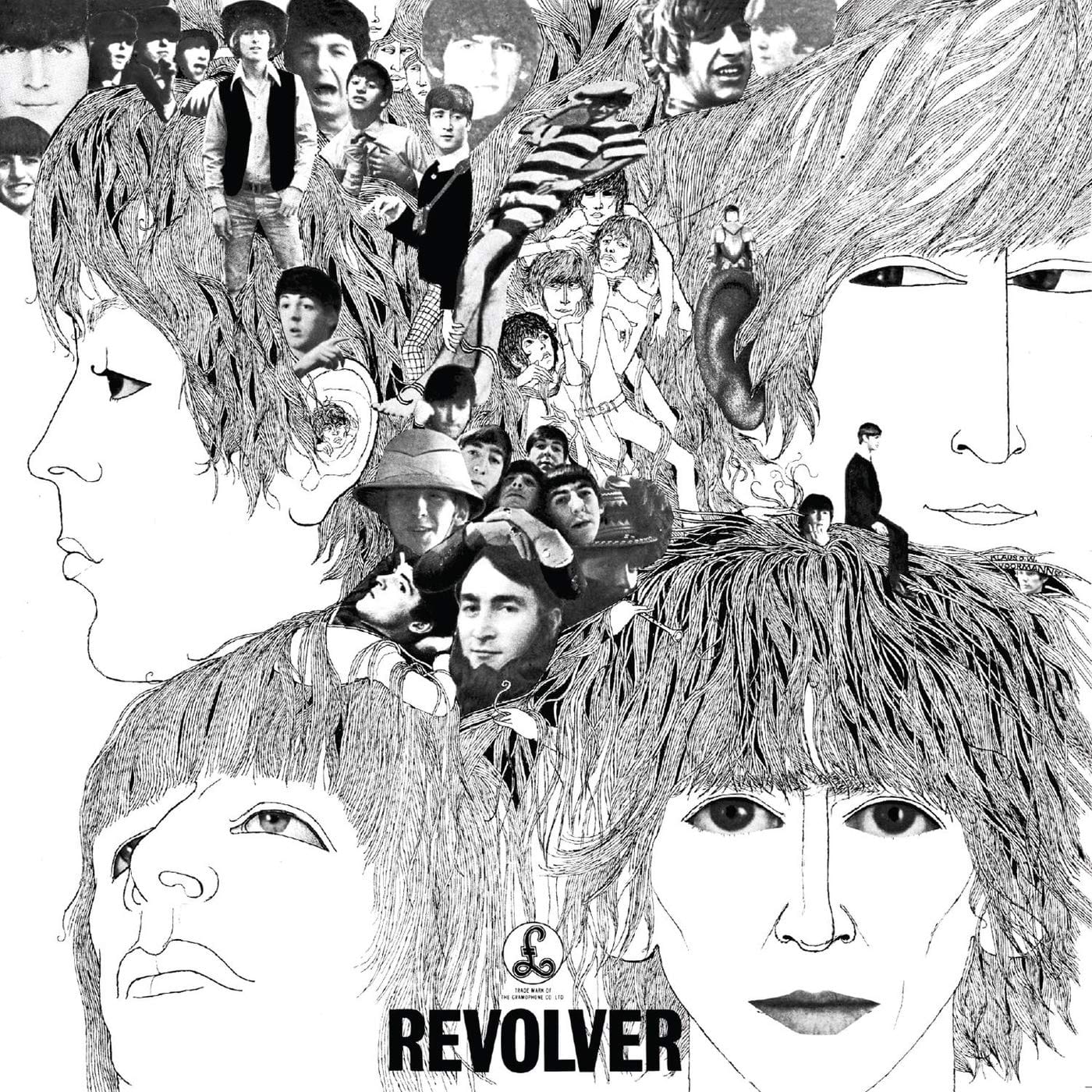
Not because it was black and white. Not because it was dramatic. But because it was different in a way I couldn't quite articulate as a kid. Hand drawn faces tangled up in hair. Small photographs tucked into the gaps. Four men and yet somehow more than four men; controlled chaos that felt like it was hiding things if you looked long enough.
I was right. It was.
Album Anatomy
| Album | Revolver |
| Artist | The Beatles |
| Released | August 5, 1966 |
| Label | Parlophone (UK) / Capitol Records (US) |
| Genre | Rock |
| On the cover | A black-and-white line drawing of the four Beatles in an Aubrey Beardsley-inspired style, interwoven with cut-out photographs of the band |
| Format | Illustration combined with photo collage |
| Design | Klaus Voormann |
| Decade | 1960s |
| Buy It | Amazon |
Hamburg, 1960
Before we can talk about the cover of Revolver, we need to go back to Hamburg in the early 1960s. Because the story of this cover begins not in a studio or a design office, but in a small club in the Reeperbahn district where a young German art student named Klaus Voormann first heard a band called The Beatles.
Voormann was no stranger to the Beatles. A bassist and visual artist himself, he met and befriended the band during the early 1960s when the quartet was playing residencies in Hamburg. They became close friends. When Voormann moved to England a few years later, he lived with George Harrison and Ringo Starr in the band's London flat after Paul McCartney and John Lennon had moved out.
In late June 1966, John Lennon called and asked if he had any ideas for the next album cover. Voormann wasn't a hired gun to complete the project. He was family.
"John called me and said, 'It's John,' and at first I was thinking, 'John who?' I didn't know who it was. Well, it's John Lennon, and he said, 'Do you have an idea for our next album cover? We don't know what we want on there, so if you have any ideas, let's see it.' Then he invited me to come down to the studio and I listened to the tracks for what would become the Revolver album."
What Voormann heard in that studio changed everything.
Tomorrow Never Knows
When he first listened to the rough tracks for Revolver, Voormann was struck by one thought: "This is gonna be a tough job to do a cover!"
"They were just rough, not finished, but it was amazing, just amazing. So many great songs. And then came 'Tomorrow Never Knows,' which was so amazing because I didn't expect it. I was sitting there listening to the tracks, and you suddenly heard those birds fluttering and sped-up tapes, backward cymbals, the guitar solo, all this rumble was going on. Immediately I was captured by it and thought it was wonderful. But when it was finished I thought, 'Oh my God, what are the fans gonna say?'"
The mission for the cover, as Voormann saw it, was to send up a flare to alert listeners that Revolver was something fundamentally different from anything The Beatles had done before. Not just a new album. A new direction. A new band, almost.
He went home to his tiny attic apartment in London and got to work.
Probably my favourite Beatles song.
Three Weeks, Pen and Ink, and Fifty Pounds
Voormann worked for three weeks in his tiny attic apartment. He used pen and black ink to create four large line drawings of the Beatles. He then combined the drawings with a collage of black and white photos.
In his line drawings of the four Beatles, Voormann drew inspiration from the work of the nineteenth century illustrator Aubrey Beardsley, who was the subject of a long running exhibition at London's Victoria and Albert Museum in 1966 and highly influential on fashion and design themes of the time.
Unifying all the images on the Revolver cover is the Beatles' hair; a swirl that gives the sleeve a psychedelic feel, even in black and white. "Hair's very important," Voormann says, "and it's very difficult for people these days to imagine how important and how sensational those haircuts were. We called The Beatles hair 'mushroomhead' in Germany. So I thought, 'That's a good idea, something with hair.' Then I came to the conclusion of using lots of hair."
The result: four faces emerging from a tangle of hair, small photographs tucked into the gaps, hand drawn and collaged and carefully composed and it was unlike anything that had appeared on an album cover before.
And it almost gave Brian Epstein a heart attack. In the best possible way.
Voormann confirms the shared story that Beatles manager Brian Epstein wept with joy when the artist presented it to him. "That was true, yes. I don't invent things," he says with a laugh. "[Epstein] really said that he was worried that the public would not accept the music, the same thought I had. He said, 'This cover is the bridge.'"
The bridge. Between the Beatles the world knew and the Beatles that Revolver was about to introduce. Epstein understood immediately what Voormann had done.
For all of this, three weeks of work, one of the most celebrated album covers in history, Voormann said the Beatles' record company paid him only about 50 pounds, roughly $140 US, in 1966. "I would have done it for nothing and I didn't feel I was in a position to make it hard for them, by saying, 'You have to pay me this or that much,'" he said. "They said 50 pounds is the absolute limit for a record sleeve."
Fifty pounds. For a Grammy winning album cover. For one of the most recognised pieces of graphic design of the twentieth century.
The Easter Egg
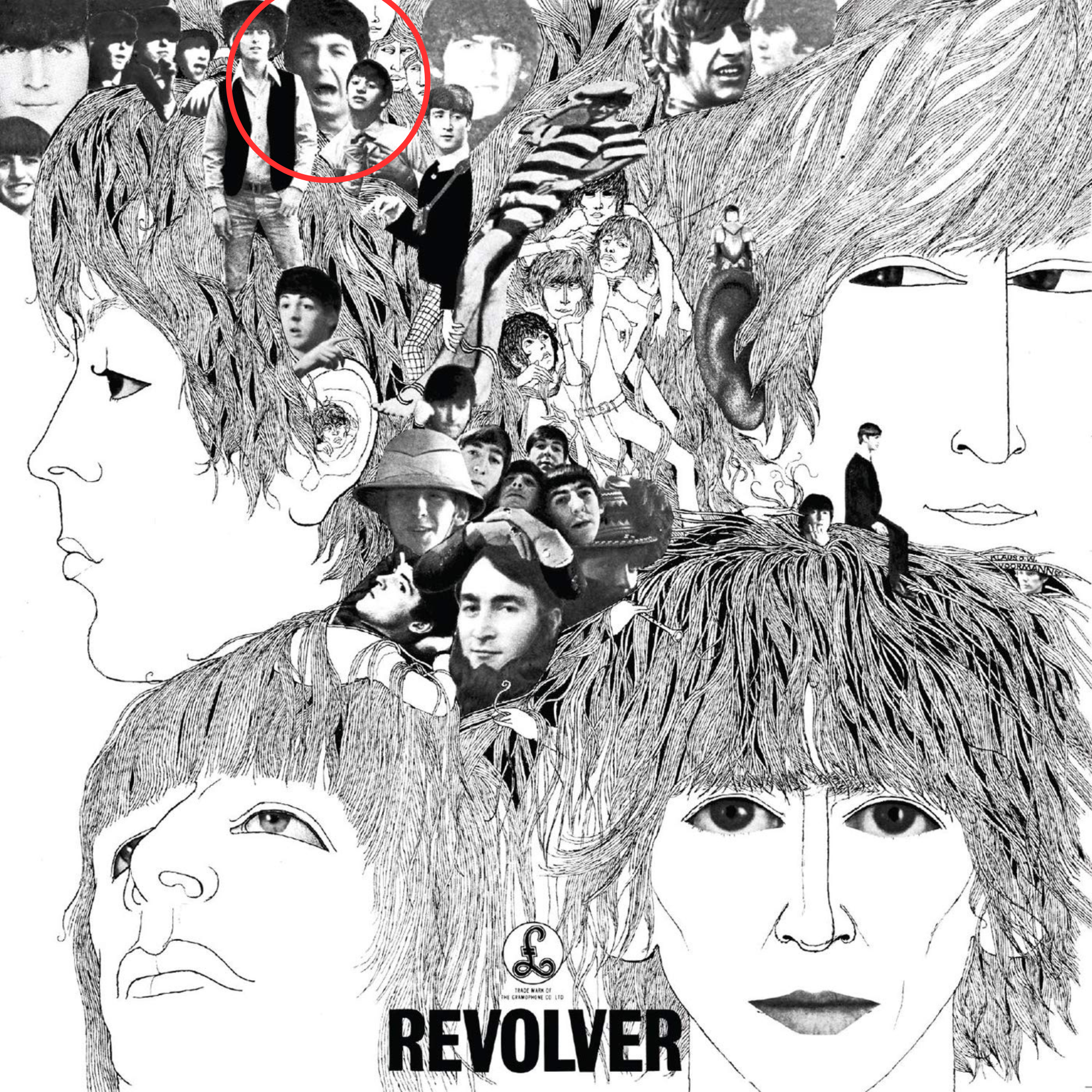
Voormann placed the various photos within the tangle of hair that connects the four faces. The drawings show each Beatle "in another state of consciousness", such that the older images appear to be tumbling out from them.
Look closely at the hair, particularly around John Lennon's face. Tucked into the swirling strands are tiny photographs of the band from earlier in their career. Older versions of themselves, younger, more innocent, pre-psychedelia, pre-Revolver, literally tangled up in the hair of their present selves.
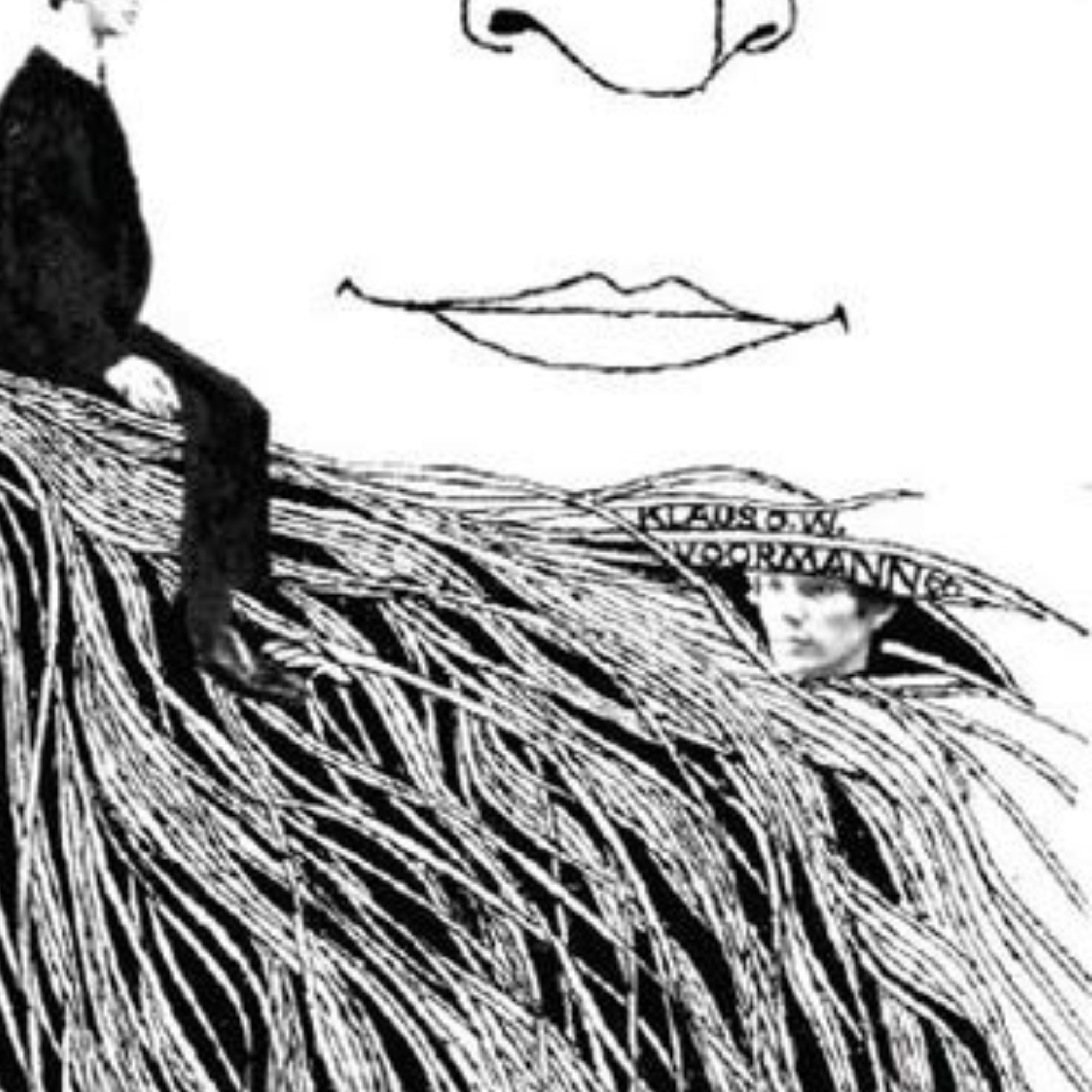
And then there is the detail that most people miss entirely. Voormann hid himself in the cover, just underneath the drawing of John's mouth. The man who made the cover concealed himself inside it. Quietly. Right there on one of the most famous sleeves in history. If you know where to look, Klaus Voormann is on the cover of Revolver.
The Grammy and The Lost Original
In March 1967, the Revolver cover won the Grammy Award for Best Album Cover. It was the first Grammy awarded to a graphically designed record cover for a rock and pop album. Voormann, by his own admission, never expected it.
And then something extraordinary happened. Or rather, something extraordinary didn't happen.
To this day, Voormann still does not know what happened to the original artwork. Supposedly, it disappeared without a trace. The original pen and ink drawings, three weeks of work in a tiny attic apartment, the Grammy winning original artwork for one of the most celebrated album covers in history simply vanished.
Somewhere out there, possibly, is the original artwork for the Revolver cover. Hanging on someone's wall. In a storage unit. Under a bed. Worth a considerable fortune and completely unaccounted for.
What The Cover Actually Says
Here is what I think about the Revolver cover now, as an adult who has spent time properly looking at it for the first time.
It is a cover that rewards attention. The more you look, the more you find. The photographs tumbling out of the hair. Voormann hidden beneath John's mouth. The psychedelic tangle that somehow holds it all together. It is a cover that respects the intelligence of the person looking at it. It assumes you will lean in rather than glance and move on.
Voormann himself said: "I'm very happy with it. There's nothing I would do differently. I think it captured what I wanted to capture. I think it's perfect."
He's right. It is perfect.
My step-dad had the Beatles box. The blue one. And a kid flicking through those sleeves stopped at Revolver every single time without knowing why.
Now I know.