The Rocket Scientist
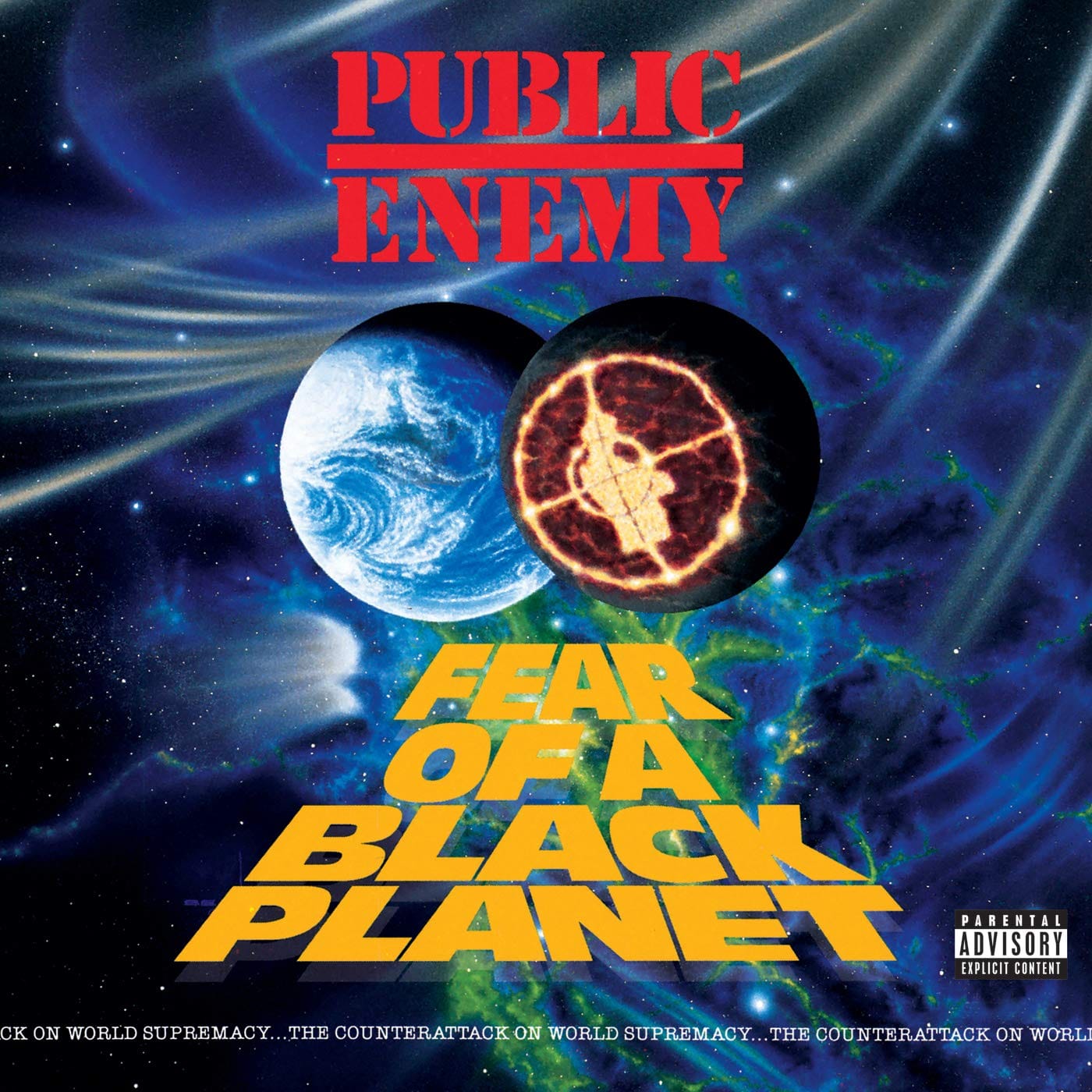
Fear of a Black Planet by Public Enemy - A hip-hop group, a NASA illustrator, and an album cover with a genuinely unlikely creative pedigree.

I almost filed this one under Sleeve Notes before I'd done a scrap of research. I assumed it'd be a quick, plain story about a striking image and not much else. I was wrong, and gladly so. This is one of my favourite finds in a while, mostly because I love hip hop, I love Public Enemy, and I didn't expect a Public Enemy cover to lead me to NASA.
| Album | Fear of a Black Planet |
| Artist | Public Enemy |
| Released | April 10, 1990 |
| Label | Def Jam Recordings |
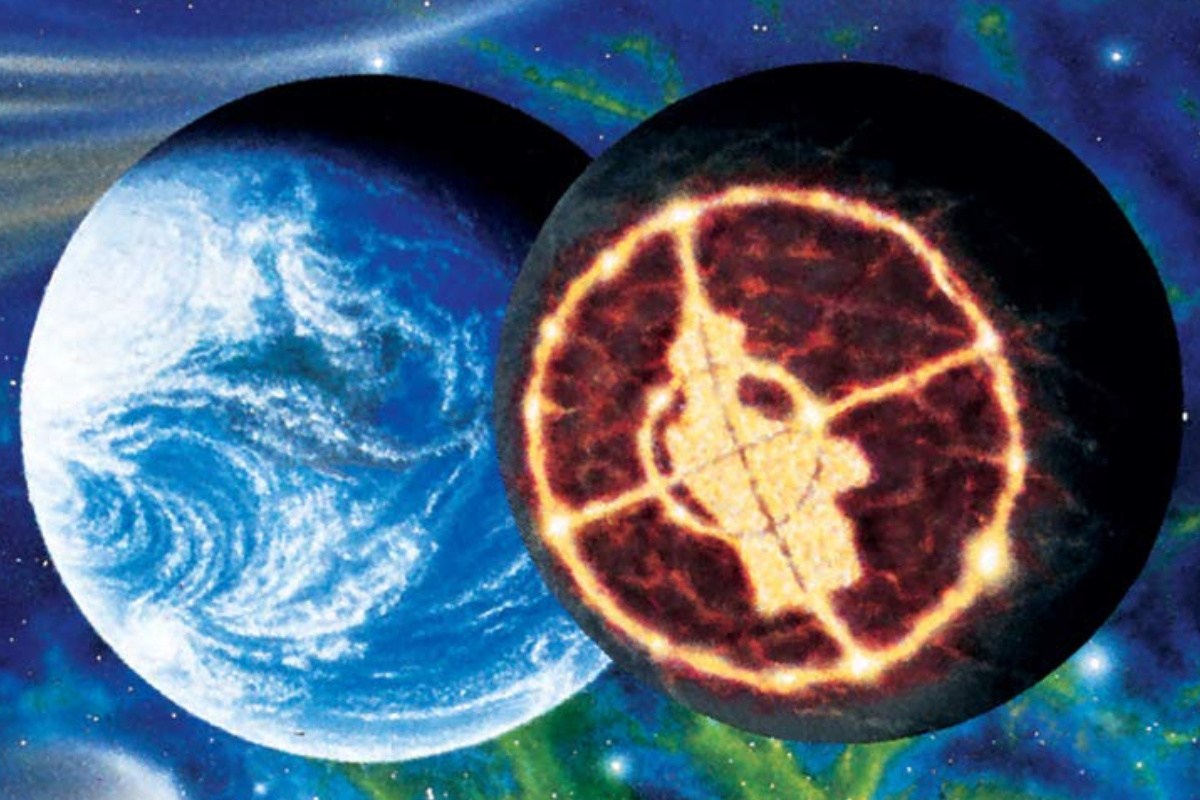
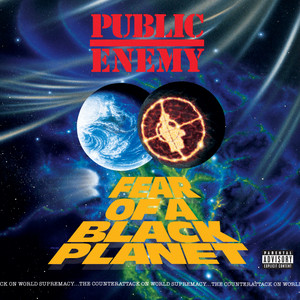
| On the cover | A black planet eclipsing Earth against a starfield, illustrated in a realistic space-art style |
| Format | Illustration (space art painting) |
| Design | Concept by Chuck D, illustration by B.E. Johnson; back cover by Cey Adams |
| Decade | 1990s |
| Buy It | Amazon / eBay |
Following An Impossible Act
By 1990, Public Enemy had a genuine problem: how do you follow It Takes a Nation of Millions to Hold Us Back, an album widely treated as a landmark the moment it came out? Chuck D has since described the whole approach to the follow-up as deliberately throwing "a hanging curve" after that record's hundred-mile fastball by doing something nobody expected rather than repeating a formula that had already worked. The group was also coming off a genuinely difficult year, having briefly disbanded after Professor Griff was fired following controversial remarks in an interview, only to reform not long after. A cover this calm and cosmic, arriving after that much noise and internal turmoil, reads less like an obvious choice and more like a deliberate change of temperature.
A Rapper Calls NASA
Most hip-hop covers in 1990 put the artist front and centre; a portrait, a pose, something that told you exactly who you were buying. Public Enemy went the opposite direction entirely, and the artist they landed on wasn't a music industry designer at all. B.E. Johnson was a NASA space artist and rocket scientist, part of the agency's official art program, known for detailed, technically accurate paintings of planets, spacecraft and astronomical events, when Def Jam contacted him directly and asked him to paint their cover. He wasn't a hip-hop fan brought in for cultural credibility, and he wasn't chosen because of any prior connection to the group. By his own account, the commission simply arrived out of nowhere, an entire career spent rendering the actual cosmos suddenly repurposed for a record about a manufactured fear of one.
Two Versions, One Winner
Chuck D came to the collaboration with a specific idea already worked out: he wanted the black planet sitting in the foreground, matched in scale to Earth rather than dwarfed by it, so the two bodies read as equals in a genuine standoff rather than one simply threatening the other. Johnson painted two versions; one that stuck closely to Chuck D's original brief, and a second, more dynamic composition that leaned into his own artistic instincts instead. By his own account, Chuck D was given full reign to pick whichever he preferred, and it was Chuck D's own concept that won out. Johnson has since said plainly that he was glad it did, and it's easy to see why. The finished image reads as a calm, almost clinical inevitability rather than a dramatic collision, which suits the album's whole argument that the fear in the title was manufactured, not earned. A more dynamic, action-oriented image might have played into exactly the kind of alarmist framing the record was trying to dismantle.
The War Room On The Back Cover
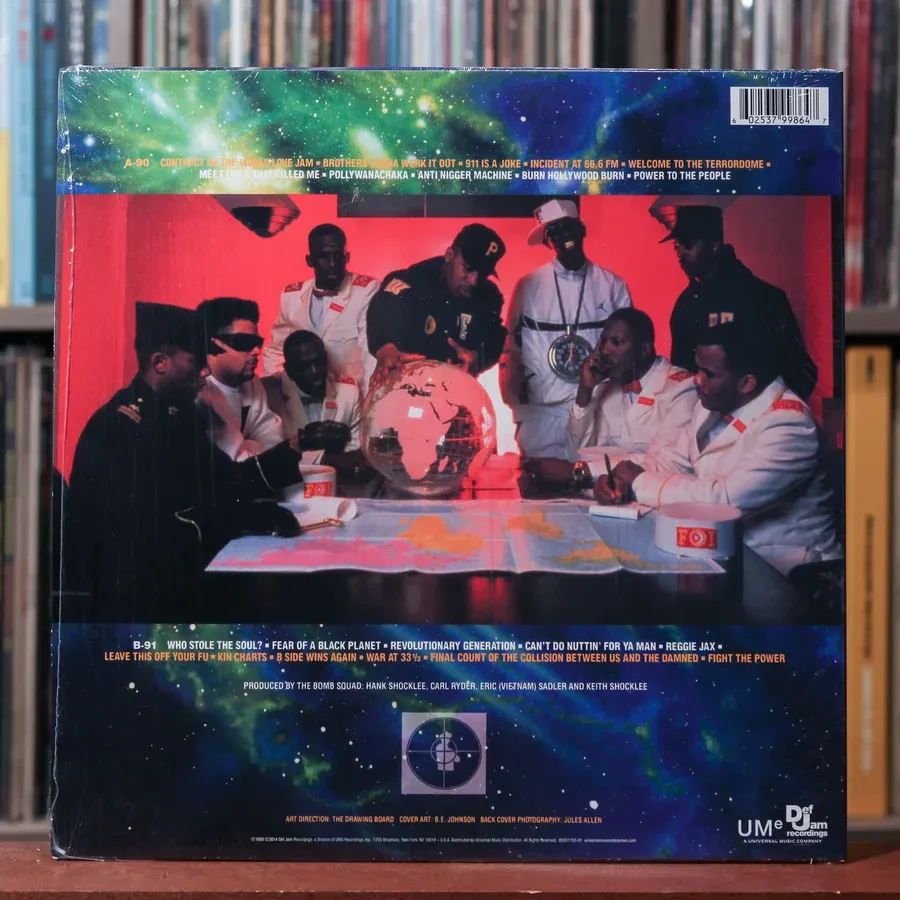
The front cover isn't the only piece of storytelling here. Def Jam's creative director Cey Adams handled the back cover separately, staging Chuck D and Flavor Flav at what looks like a military planning table, poring over a world map, flanked by Professor Griff and Terminator X, with production team The Bomb Squad consulted like field commanders. Where the front cover suggests something enormous and cosmic is coming, the back cover grounds it in something closer to a briefing room; as if the eclipse on the front were simply the outcome of a plan actually being drawn up on the back. Seen together, the two covers form a complete before-and-after: strategy on one side, consequence on the other.
An Album Built The Same Way
There's a neat parallel between that back-cover war room and how the record itself was actually made. The Bomb Squad built Fear of a Black Planet out of an estimated 150 to 200 samples, layering funk, rock, jazz and found sound; James Brown, Funkadelic, sirens, snatches of speech into a single dense wall of noise, a level of sample density that would be prohibitively expensive to clear today, and one nobody has really been able to replicate since sample-clearance laws tightened not long afterward. A cover depicting many different forces coordinating toward one outcome turns out to be a fairly accurate description of the production process happening underneath it: dozens of borrowed pieces, none of them originally intended to sit together, arranged into a single deliberate result.

A Long Afterlife
The cover's reputation has only grown since 1990. VH1 named it one of the greatest album covers ever made, and in 2016, more than a quarter-century after the original commission, Def Jam sent Johnson a gold-plated vinyl pressing of the album as a personal thank-you. A rare gesture toward an illustrator who, by most accounts, had no ongoing relationship with the label beyond that one job. The image has since been licensed for a Public Enemy collaboration with Supreme and Undercover, putting a rocket scientist's space painting on streetwear decades after it first went to print, worn by people who most likely have no idea a NASA artist made it. The album itself was added to the National Recording Registry in 2005, officially recognised as culturally significant enough to preserve, cover art and all.
I thought this one would be a quick write-up. Sometimes the best stories aren't hiding behind controversy or scandal. Sometimes it is just an unlikely phone call between a record label and a rocket scientist, and both sides taking the collaboration seriously.