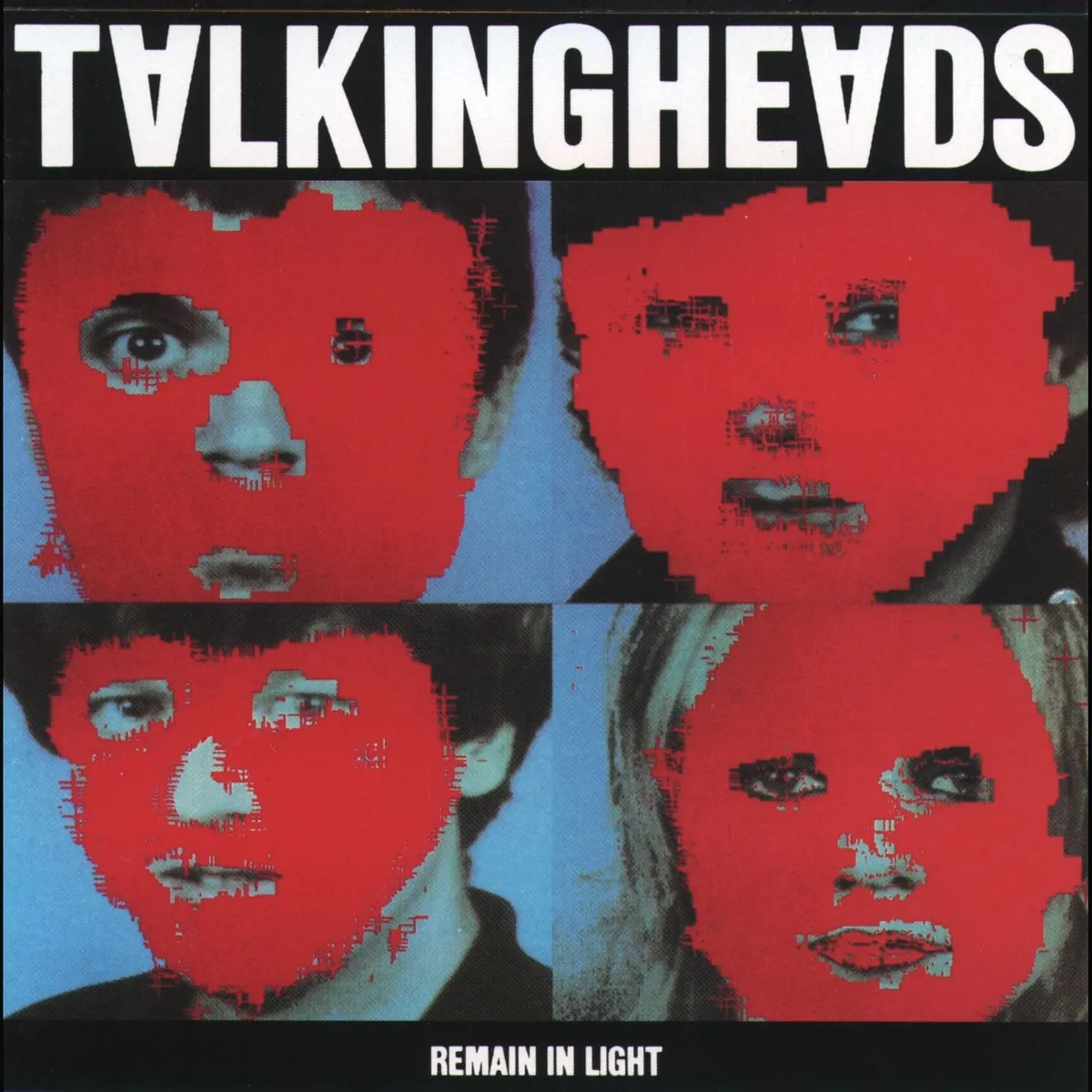
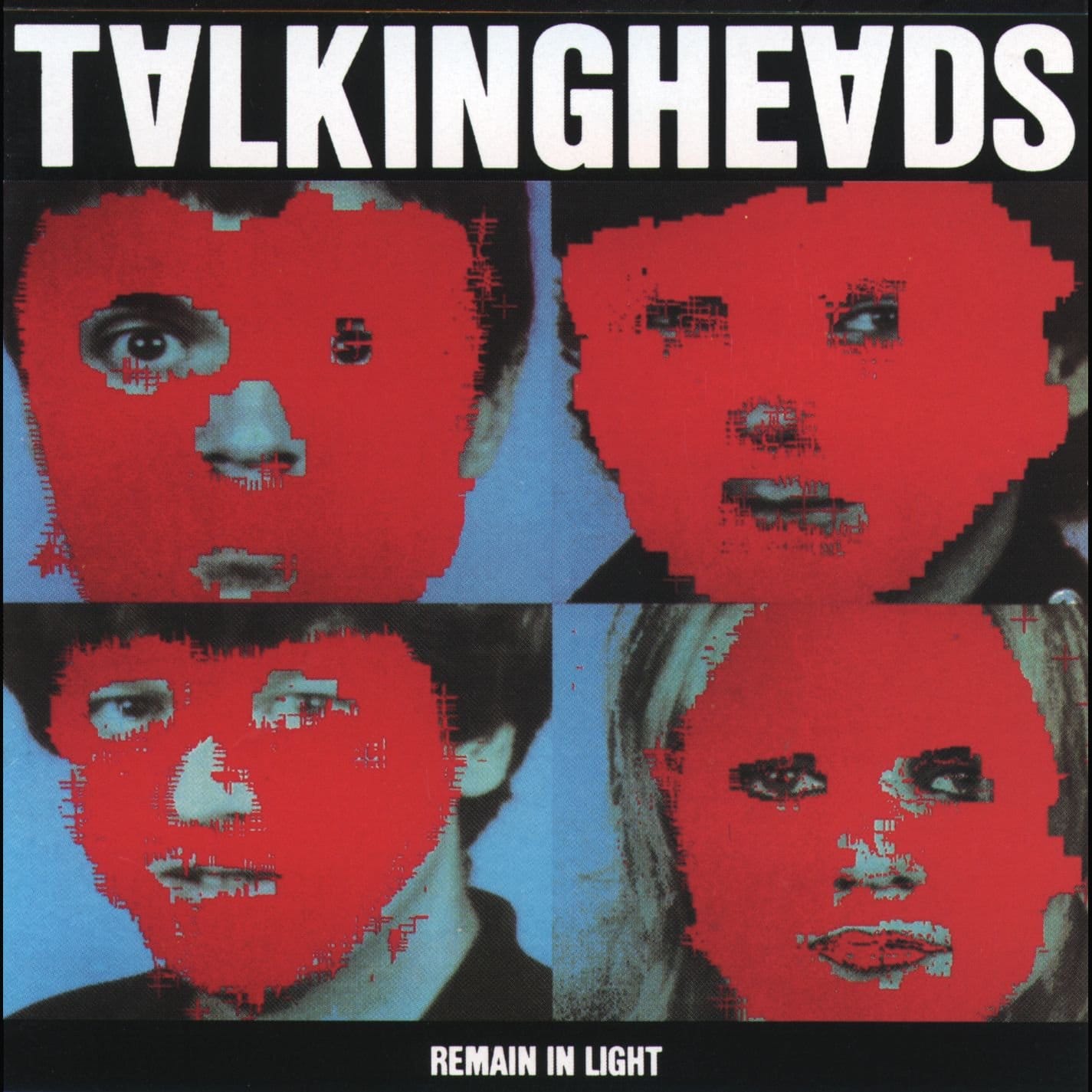
If you've ever flicked past this cover in a record shop and assumed the factory had botched the print run, you're in good company. Four faces smeared with red, as if someone dragged a wet thumb across the plates before the ink dried. It looks like a mistake. It wasn't. The Remain In Light album cover is one of the earliest sleeves ever made with a computer, and the computer in question lived at MIT.
Album Anatomy
| Album | Remain In Light |
| Artist | Talking Heads |
| Released | 8 October 1980 |
| Label | Sire Records |
| On the cover | The four band members, each blotted out by a block of red |
| Back cover | Red warplanes flying in formation over mountains |
| Design | Tibor Kalman (M&Co) |
| Built by | Tina Weymouth and Chris Frantz, with Walter Bender and Scott Fisher at MIT |
| Genre | Alternative |
| Decade | 1980s |
| Buy It | Amazon |
| Listen | Amazon Music / Spotify |
Four Faces And A Very Big Computer
While Brian Eno and David Byrne worked away in the control room, Tina Weymouth and Chris Frantz took charge of the artwork. Through contacts at MIT they ended up working with researchers Walter Bender and Scott Fisher, who helped them do something almost nobody had done: put a computer to work on an album cover.
This was the summer of 1980. MIT's mainframe reportedly took up several rooms, and the process was painfully slow. Weymouth kept turning up through the summer to work on it. What came out the other end was a portrait of each band member, blotted out with a block of red.
I'd love to tell you it was definitely the first computerised cover ever made, and plenty of writers do. The sources I could find say "one of the first", so that's what I'll say too, just to be safe.
Why Hide Their Faces?
The mask idea came from Weymouth, who was fascinated by them: the way a mask hides one identity and invents another. That's a neat fit for an album so preoccupied with the self. "Once In A Lifetime" and "Seen And Not Seen" both circle the gap between the face you show the world and whatever's underneath.
To my eye there's another message in there too. All four faces get identical treatment. No frontman, no hierarchy, nobody more visible than anybody else. That suits a record built from communal jam sessions, cut up and looped, and inspired by African music, Fela Kuti especially.
The Sleeve That Nearly Swapped Sides
The image on the back, those red warplanes over the Himalayas, was originally meant for the front. The masked faces were destined for the back. At some point the two swapped, and the cover we know became the cover we know. The planes are usually read as a nod to Weymouth's family background, since her father had a military career.
Who Actually Designed It?
Credit gets murky here. Tibor Kalman, of M&Co in New York, is the name on the design credit. But at least one account says his real contribution was the lettering, those upside-down A's in TALKING HEADS, while the imagery came from Weymouth, Frantz and the MIT team. I'll leave the argument open for you to decide, let me know what you think in the comments below.
Look Twice
So next time you flick past Remain In Light in a record shop, give the factory the benefit of the doubt. Nothing went wrong. Four faces, hidden on purpose, made by people who'd worked out how to get a room-sized computer to draw a mask. It only looks like a printing error because so few people had seen anything like it before.