I was in high school when Appetite For Destruction came out in 1987. We all loved it. Welcome to the Jungle. Paradise City. Sweet Child O' Mine. Axl's scream. Slash's hair. Great memories.
But here's the thing. The cover I had in my head, the one I associated with that album, those memories, that era, was the cross and skulls design. Dark, slightly gothic, unmistakably Guns N' Roses. I assumed that was always the cover.
It wasn't. There was another one. And most of the world never saw it.
Album Anatomy
| Album | Appetite for Destruction |
| Artist | Guns N' Roses |
| Genre | Rock |
| Released | 21 July 1987 |
| Label | Geffen Records |
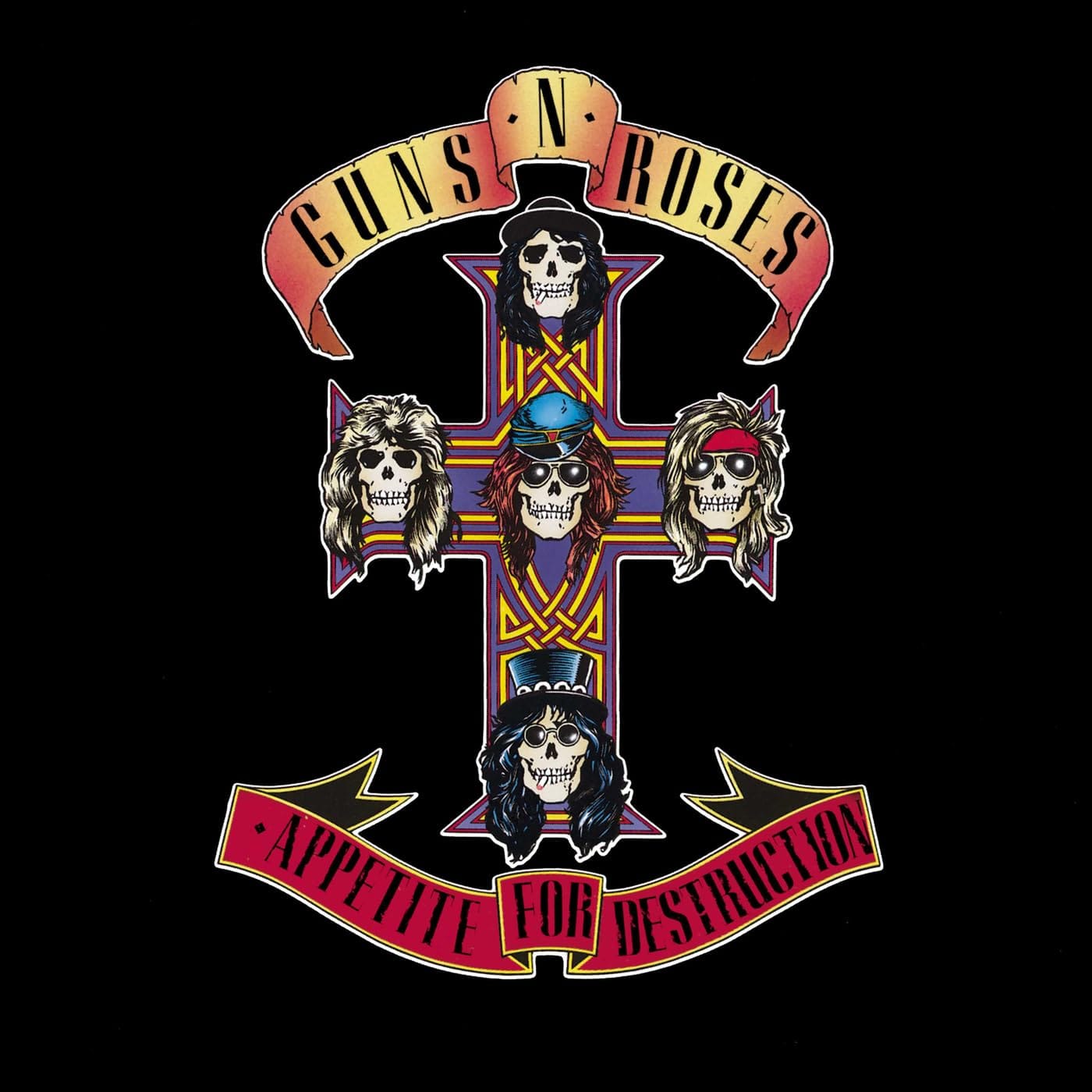
| On the cover | A Celtic cross with five skulls representing each band member - the replacement cover, after retailers refused to stock the original |
| Design | Cross design by Billy White Jr. and Axl Rose (final cover); original painting by Robert Williams, relegated to the inner sleeve |
| Decade | 1980s |
Robert Williams and the Underground
Before we talk about the cover, we need to talk about the artist who painted it.
Robert Williams came out of the underground comix scene of the 1960s. A movement that deliberately operated outside the mainstream art world, embracing the grotesque, the surreal and the deliberately offensive as legitimate artistic tools. He had worked for Ed "Big Daddy" Roth, the legendary hot rod customiser and creator of Rat Fink, and had spent years developing a bold, graphic style that the fine art establishment wanted absolutely nothing to do with.
Williams wasn't an unknown shock merchant. He'd come out of the underground comix scene and lowbrow art world, where offence wasn't a side effect, it was often the point.
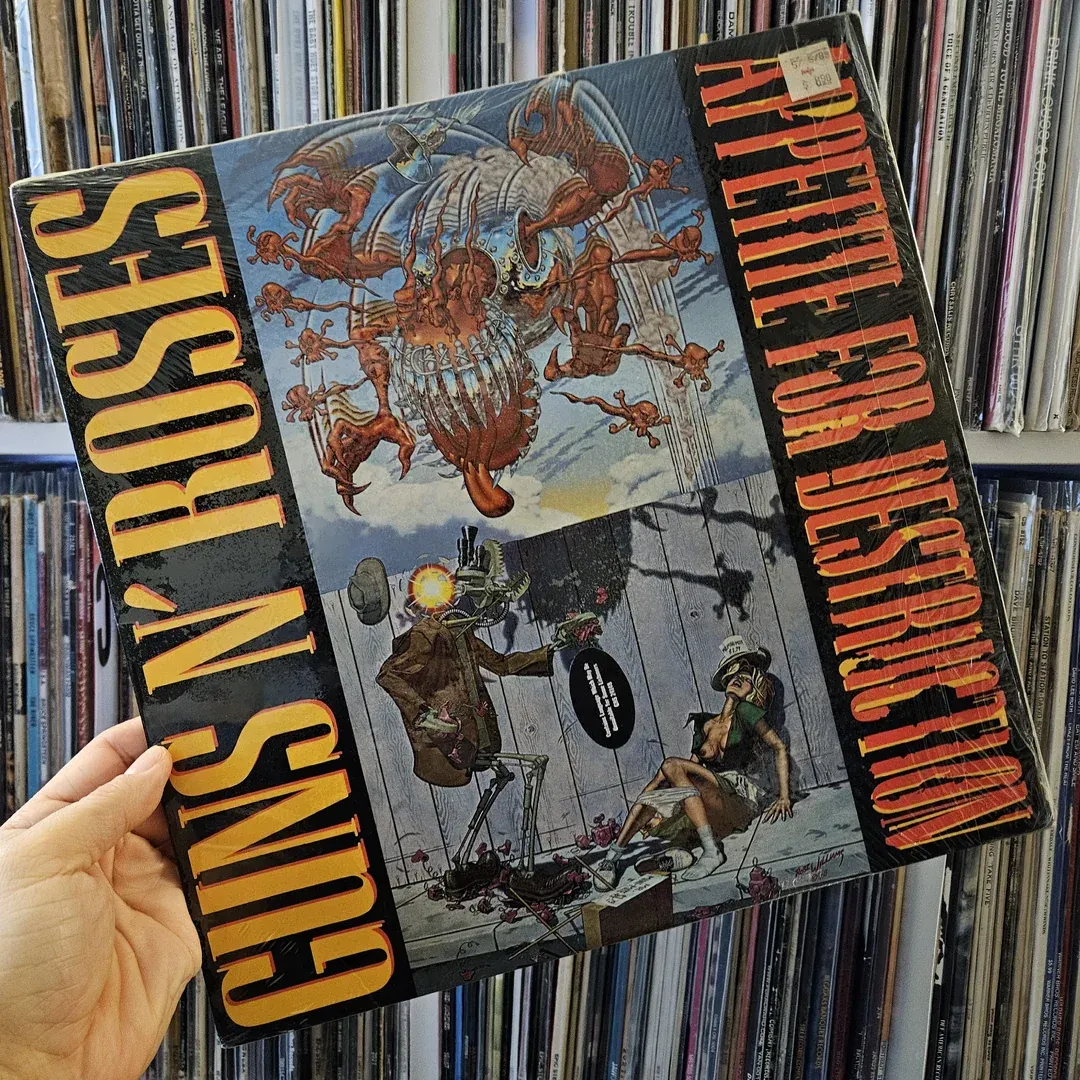
His painting Appetite For Destruction, completed in 1978, depicted a robotic figure standing over a woman in a scene of sexual violence, with a metal avenger looming above. It was not a comfortable image. It was not meant to be. The painting was originally a postcard that could be bought in at least one museum gift shop in the late 70s and early 80s.
A postcard. In a museum gift shop. The image that would eventually cause one of the biggest cover controversies in rock history was available as a postcard.
Axl's Joke
Axl Rose saw the postcard and loved it. He pitched it as the album cover as a joke, thinking it was too ridiculous to actually happen. Geffen went for it.
He was joking. The record label said yes. And suddenly Guns N' Roses had a debut album with a painting depicting sexual violence on the front cover.
Williams himself could see exactly what was coming. "I suggested that they come over to my house and look through some slides and pick something else for the cover," Williams once told Revolver magazine, "because I knew they were gonna get in trouble with it."
The artist warned them. Axl was joking. And Geffen said yes. Everything about this story is completely chaotic and completely Guns N' Roses.
The Recall
The reaction was swift and decisive.
Both American and British retail chains refused to stock the album. Geffen quickly forced the band to find a replacement and another edition was printed with a new cover. Williams' painting was moved to the inner sleeve.
In Australia, the cross and skulls version was almost certainly the only one that made it to shelves. The original would have had extremely limited international distribution before the recall kicked in. The only place I remember seeing the brutal cover was on t-shirts.
The Tattoo That Became A Logo
So where did the cross and skulls design come from?
"One day Axl called and asked if I could draw him a tattoo, after he'd seen a drawing I'd done on my cousin's wall," artist Billy White Jr recalled. "I said sure, and we talked. The cross and skulls that looked like the band was Axl's idea. The rest was me. The knot work in the cross was a reference to Thin Lizzy, a band Axl and I both loved."
A tattoo design. Drawn as a personal favour. With a nod to Thin Lizzy hidden in the knotwork.
"Axl called again and said my design was going to be on the cover of everything, because the Williams painting got rejected," White said. "I was okay with that."
He was okay with that. The most recognisable logo in hard rock history, the design that would appear on millions of t-shirts, posters, patches and tattoos around the world, and the man who drew it was okay with that.
What The Two Covers Actually Say
The original Williams painting is genuinely difficult to look at. As a teenager I saw it on t-shirts without fully understanding what I was looking at. The image is dark, deliberately provocative and, once you understand what it depicts, it is genuinely uncomfortable. That discomfort was Williams' point. It always was.
But the cross and skulls replacement is interesting too. Five skulls, one for each band member, arranged around a Celtic cross with Thin Lizzy knotwork hiding in the design. It is gothic and aggressive but also personal. Each skull is a band member. Each member is represented. It is, in its own way, a portrait.
Appetite For Destruction has sold close to 30 million copies worldwide, making it the best selling debut album in history. The cover that most of the world knows is the one drawn as a tattoo by a friend who was okay with it going on the front of a record.
The cover that caused the controversy is the one most people have never actually seen.
Welcome to the jungle indeed.