This post is different to anything else I've written on Art Before Noise so far. Granted, I have only written 6 posts before this one. However, this involves real people, real tragedy, and real consequences. It deserves to be handled with care. So that's what I'm going to try to do.
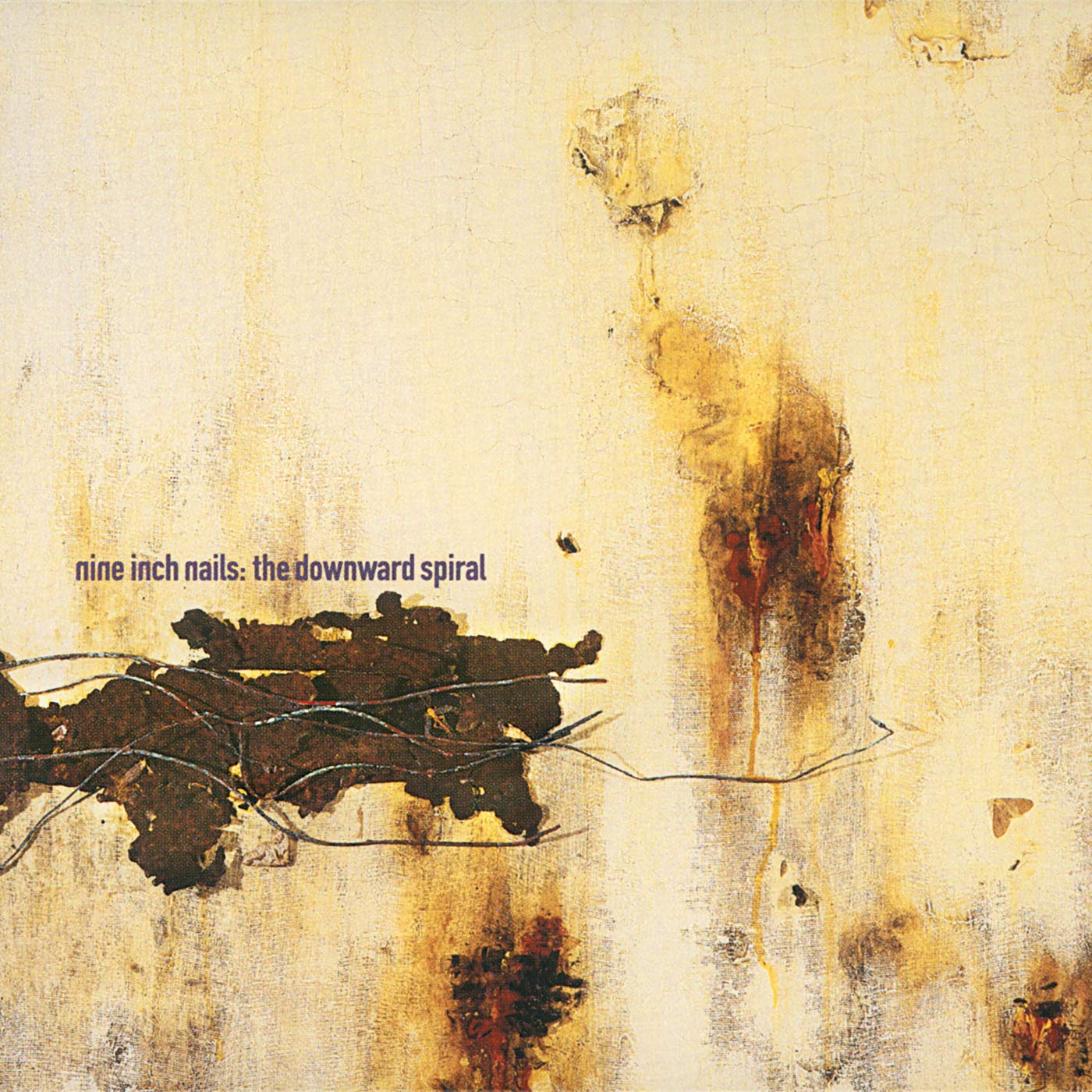
Nine Inch Nails are one of the great bands. The Downward Spiral is one of the great albums of the 1990s. And its cover, a blurred, abstract image of what appears to be a wall or a surface, dark and indistinct never really stood out to me. I assumed it was some sort of Trent Reznor art project. Dark imagery for a dark album. I think most people would agree?
I had no idea what I was actually looking at.
Album Anatomy
| Album | The Downward Spiral |
| Artist | Nine Inch Nails |
| Released | 8 March 1994 |
| Label | Nothing Records / Interscope Records |
| On the cover | A close-up, heavily processed and abstract image; dark, textured and difficult to read, widely interpreted as evoking the walls of the house where it was recorded |
| Design | Artwork by Russell Mills; photography by David Buckland |
| Decade | 1990s |
The Night of August 9, 1969
Before we can talk about the album, we need to talk about what happened at 10050 Cielo Drive in Benedict Canyon, Los Angeles, on the night of August 9, 1969.
The home became the scene of the murders of the eight-months-pregnant Sharon Tate, Wojciech Frykowski, Abigail Folger, Jay Sebring, and Steven Parent, committed by Tex Watson, Susan Atkins, and Patricia Krenwinkel; members of the Manson Family cult.
Sharon Tate was 26 years old. She was a rising Hollywood actress, the wife of director Roman Polanski, and eight months pregnant with their son. She died alongside four others in one of the most shocking acts of violence in American history.
The murders cast a shadow over Hollywood and over an entire generation. Author Joan Didion wrote: "Many people I know in Los Angeles believe that the Sixties ended abruptly on August 9, 1969, ended at the exact moment when word of the murders on Cielo Drive traveled like brushfire through the community."
The house at 10050 Cielo Drive stood for another 25 years. And then Trent Reznor moved in.
The Cheapest House On The List
In Reznor's own words: "We were looking for a place to work on the album, and I saw a number of places, and one of them happened to be the house where the Tate murders occurred. But no one told us that. You can imagine a realtor not wanting to mention that. I just didn't know. That place sits up on a hill overlooking Beverly Hills, with the ocean on one side and downtown in the other direction. It was a cool, tranquil little ranch house with a nice yard. And it was cheaper than the rest of them. That's always a clue."
A few weeks after moving in, a friend noticed something. They got a copy of Helter Skelter, the definitive account of the Manson murders and checked. There was the same bedroom. The same front door. The same pool.
Reznor already knew about the Manson murders. He had read Helter Skelter as a kid. And now he was living in the house where it happened.
What he did next is where the controversy begins.
Le Pig
Rather than move out, Reznor stayed. He transformed the house into a recording studio and named it "Le Pig", a reference to the word "Pig" that murderer Susan Atkins had written in Sharon Tate's blood on the front door of the house on the night of the murders.
He also recorded the music video for "Gave Up" at the property, and brought in Marilyn Manson, an artist whose name was itself constructed by combining Marilyn Monroe and Charles Manson, to record sections of his debut album there.
The album being recorded in this house was The Downward Spiral. A concept album about self destruction, violence, addiction and suicide. The darkest album of Reznor's career, made in the darkest location imaginable.
Reznor called his first night in the house "terrifying." He stayed for eighteen months.
The Moment Everything Changed
Whatever you think of Reznor's decision to record there, what happened next is impossible not to respect.
One day, during the recording sessions, Reznor had a chance encounter with Sharon Tate's sister, Patti. She asked him directly: "Are you exploiting my sister's death by living in her house?"
In his own words: "For the first time the whole thing kind of slapped me in the face. I said, 'No, it's just sort of my own interest in American folklore. I'm in this place where a weird part of history occurred.' I guess it never really struck me before, but it did then. She lost her sister from a senseless, ignorant situation that I don't want to support. When she was talking to me, I realized for the first time, 'What if it was my sister?' I thought, 'Fuck Charlie Manson.' I went home and cried that night."
Reznor moved out in December 1993, later explaining: "There was too much history in that house for me to handle."
The Door
Here is the detail that makes this story truly extraordinary.
When Reznor moved out of 10050 Cielo Drive, he took the notorious front door with him. The door that still had Sharon Tate's blood concealed beneath layers of paint and installed it as the entrance to his new recording studio in New Orleans, a former funeral home, where he recorded The Fragile in 1999.
The house itself was demolished in early 1994, shortly after Reznor moved out. A new house was constructed on the site and the address was changed to 10066 Cielo Drive. The new owner told Los Angeles magazine: "We went to great pains to get rid of everything. There's no house, no dirt, no blade of grass remotely connected to Sharon Tate."
The door eventually passed from Reznor's possession and was later put up for auction through Julien's Auctions. A piece of one of history's darkest nights, sold to the highest bidder. It is a deeply uncomfortable conclusion to an already uncomfortable story.
The Cover
Remember, this blog is about the art of the cover. The Art Before Noise. So, what the hell does all of this have to do with the album cover?
The cover of The Downward Spiral is a close up, heavily processed photograph; abstract, dark, and difficult to read. It has been interpreted as a wall, a surface, a texture. Some have suggested it references the walls of 10050 Cielo Drive. Others see it as purely abstract imagery in keeping with the album's themes.
Reznor has never fully explained it. Which feels right. Some things are better left without an explanation.
What I know is this. The first time I looked at that cover I thought it was just something that Reznor had thrown together for the cover. It is a light texture. There are some dark spots. There is background noise. But now that I know where this album was made, and what happened in that house, and what it cost everyone involved, the cover looks different to me.
It looks like a wall that has absorbed too much history. Dark, indistinct, impossible to fully understand.
That might be exactly what it is.
Art Before Noise acknowledges the victims of the Tate murders: Sharon Tate, Wojciech Frykowski, Abigail Folger, Jay Sebring, and Steven Parent. Their lives mattered far more than any album.