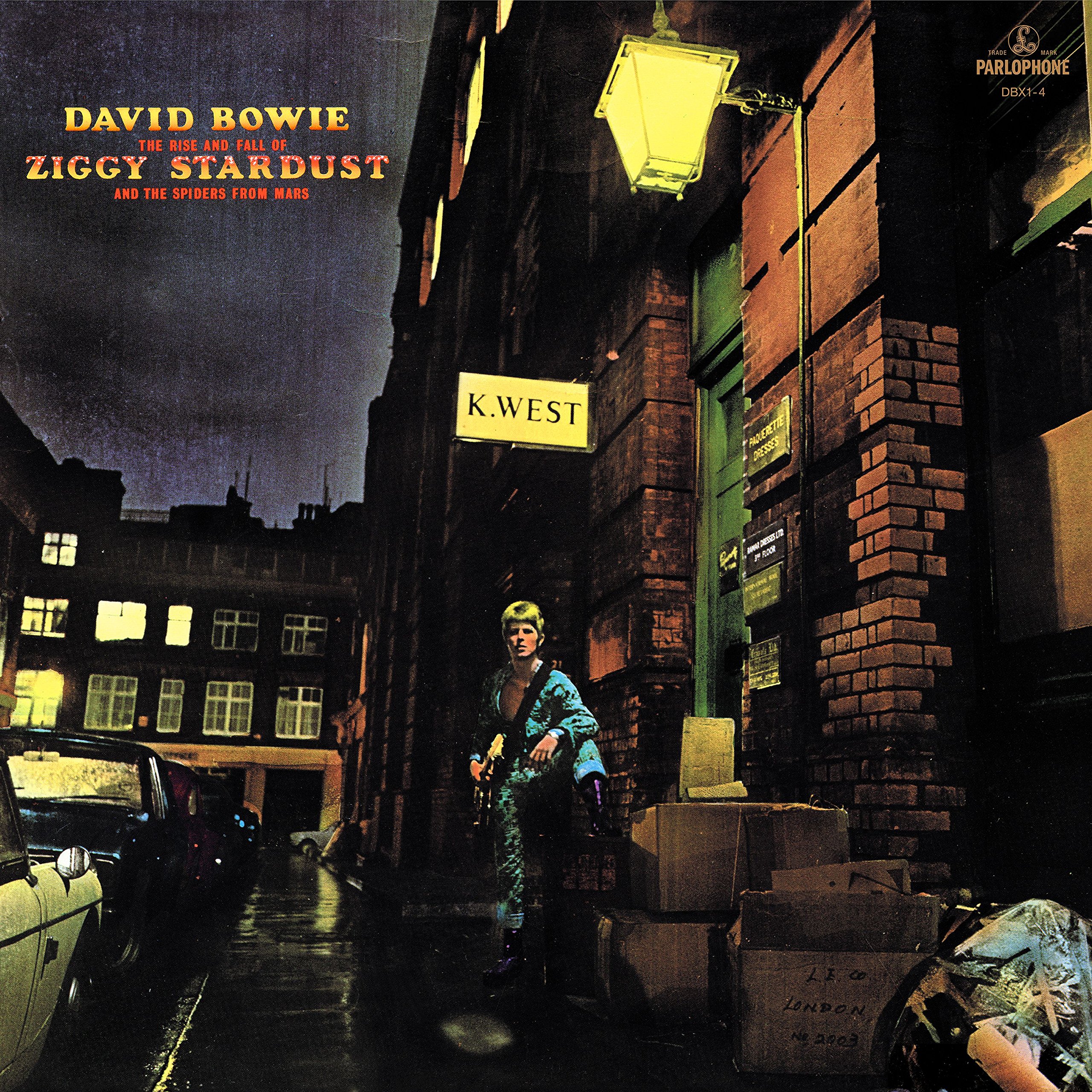
On the cover of The Rise and Fall of Ziggy Stardust and the Spiders from Mars, David Bowie is not the cover. Not really. He's in it. Standing under a glowing sign on a dark, wet London street, guitar slung over his shoulder, one foot resting on something just out of frame. But he doesn't fill it. The street fills it. The darkness fills it. Bowie is just a small figure in a scene rather than the subject of a portrait.
For one of the most famous album covers in history, that restraint is remarkable.
Album Anatomy
| Album | The Rise and Fall of Ziggy Stardust and the Spiders from Mars |
| Artist | David Bowie |
| Released | 16 June 1972 |
| Label | RCA Records |
| On the cover | Bowie as Ziggy Stardust, small in frame, standing under the K. West sign on a rain-soaked Heddon Street, guitar slung over his shoulder |
| Design | Photography by Brian Ward; colourised by Terry Pastor |
| Decade | 1970s |
Who Was Ziggy Stardust?
Before we get to the street, we need to understand who is standing on it.
By January 1972, David Bowie had released four studio albums to modest success. He was known, but not famous. Respected, but not iconic. He was searching for something different, something that would break through and would be as much a creative statement as a commercial one.
What he landed on was one of the most audacious ideas in rock history. He would create a character, a fictional alien rock star named Ziggy Stardust, and he would become that character. Not as a costume or a gimmick, but as a sustained act of performance art that would blur the line between David Bowie the man and Ziggy Stardust the alien so thoroughly that even Bowie himself would struggle to find his way back.
The album tells the story of an alien who comes to Earth, becomes a rock star messiah, gets consumed by fame and excess, and is ultimately destroyed by it. It is, in other words, a warning. And Bowie proceeded to live it out in real life almost exactly as the story described.
A Brooklyn Alley in London
The photos for the front and rear of the Ziggy Stardust album were taken on 13 January 1972 on a cold, wet night by photographer Brian Ward, who had a first-floor studio at Heddon Street, London.
Heddon Street is a small, narrow backstreet just off Regent Street in central London. It is not glamorous. It is not particularly interesting. In 1972 it was lined with ordinary businesses and lit by ordinary streetlamps. According to Ward, Bowie had phoned him requesting a shooting location resembling a "Brooklyn alley scene" where he could appear alone like an alien being. Ward said: "He was playing on this Man from Mars thing. He wanted to come over like a real stranger, like a science fiction movie."
The location was largely chosen for practical reasons, it was right outside Ward's studio. But what felt like a compromise turned into something extraordinary.
After a while inside the studio, Ward suggested taking the shoot outside to catch the last light of the winter day. But it was cold, and it had started to rain, and the band were not eager to go outside and freeze. So Bowie grabbed a red Les Paul guitar he had borrowed from his friend Mark Pritchett, and headed out with Ward alone.
Bowie wore a green jumpsuit, later featured in a performance on BBC music show The Old Grey Whistle Test, but hand coloured to appear blue on the sleeve. Bowie later said of the shoot: "It was cold and it rained and I felt like an actor."
Altogether, 54 photos were taken. Outside on the wet street. In and around a red telephone box. Against damp brick walls. One of them, Bowie standing under the K. West sign, guitar slung over his shoulder, foot raised, the rain-slicked street stretching out behind him. This was the photo that became the one.
The Colour That Changed Everything
The original photographs were shot entirely in black and white. What you see on the album cover, the vivid turquoise jumpsuit, the bright yellow hair, the otherworldly glow, is not what Brian Ward captured on Heddon Street that night.
RCA Records sent the black and white pictures to designer Terry Pastor to colourise them. He had worked with Bowie previously on the Hunky Dory album cover. Pastor chose bright colours for Ziggy Stardust's jumpsuit and hair, making him pop against the dark alley; reinforcing the concept of an alien descending to earth.
It was a masterstroke. The dark, wet, ordinary London street became a landing pad. The unremarkable figure in the doorway became something genuinely otherworldly. The colourisation didn't just change how Bowie looked, it changed what the cover meant.
The K. West Sign
Look at the cover and above Bowie's head, slightly out of focus, you can read the letters K. West. You really can't miss it. It was the sign for a furrier (a business that sold fur coats)that occupied part of the premises at 23 Heddon Street.
It meant nothing. It was just there.
And yet. Bowie later told Rolling Stone: "It's such a shame that sign went. People read so much into it. They thought K. West must be some sort of code for quest. It took on all these sort of mystical overtones."
The internet has since gone further. Some fans have pointed out that Kanye West, born in June 1977, five years after the album's release shares his surname with the sign. The album's opening track is called Five Years. Bowie, some suggest, predicted Kanye. It is the kind of conspiracy theory so absurd it almost earns respect.
The sign was removed by an enthusiastic Bowie fan in 1982. A replacement was later installed. Somewhere, presumably, someone still has the original.
The Plaque For A Fictional Character
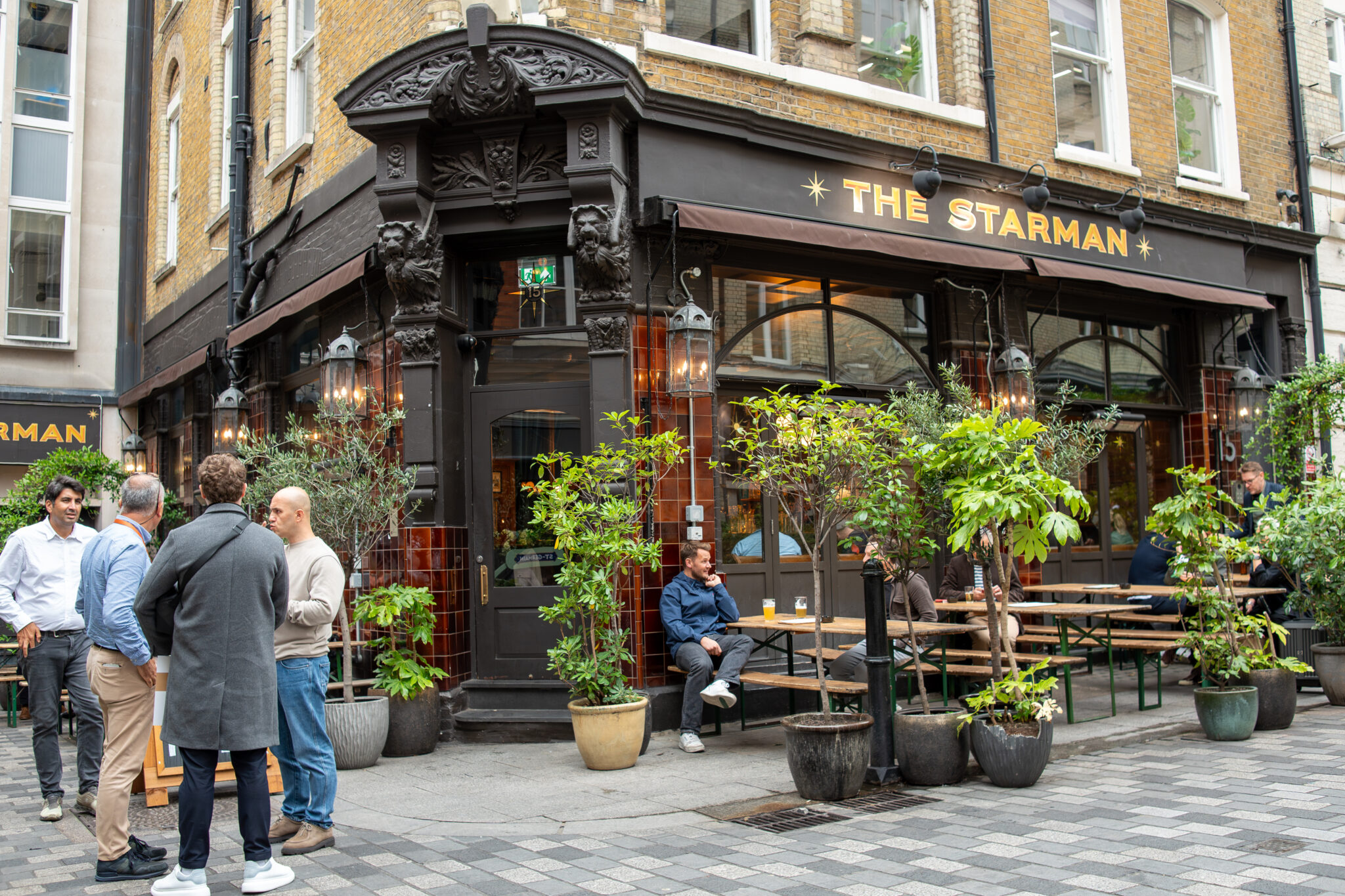
Heddon Street today is almost unrecognisable from the narrow, rain-soaked backstreet in the photograph. It has been pedestrianised, lined with restaurants and bars, and has become something of a Bowie pilgrimage site. It is the the Abbey Road zebra crossing of the Bowie world.
In 2012, a commemorative plaque was installed at Number 23, Heddon Street, unveiled by Spandau Ballet guitarist and Bowie superfan Gary Kemp. It states: "Ziggy Stardust 1972 - This marks the location of the cover photograph for the iconic David Bowie album The Rise and Fall of Ziggy Stardust and the Spiders from Mars."
The plaque is one of just a small handful in London extended to fictional characters, alongside Sherlock Holmes and Lara Croft.
A plaque. For an alien. On a backstreet off Regent Street. Where a man stood in the rain holding a borrowed guitar for less than an hour on a January night in 1972.
Where Is He?
The first time I saw this cover, my first thought was: Where is he?
Now, I know. He's on Heddon Street, London. He's standing under a furrier's sign that would be stolen a decade later. He's wearing a green jumpsuit that would be coloured blue by a designer in a separate room weeks afterwards. He's holding a guitar that isn't his. It's raining.
And he is in the process of becoming one of the most iconic figures in the history of popular music.
The cover works because Bowie understood something that very few artists understand; that mystery is more powerful than presence. By not filling the frame, by letting the street and the darkness and the rain do the work, he created an image that pulls you in rather than pushing itself at you.