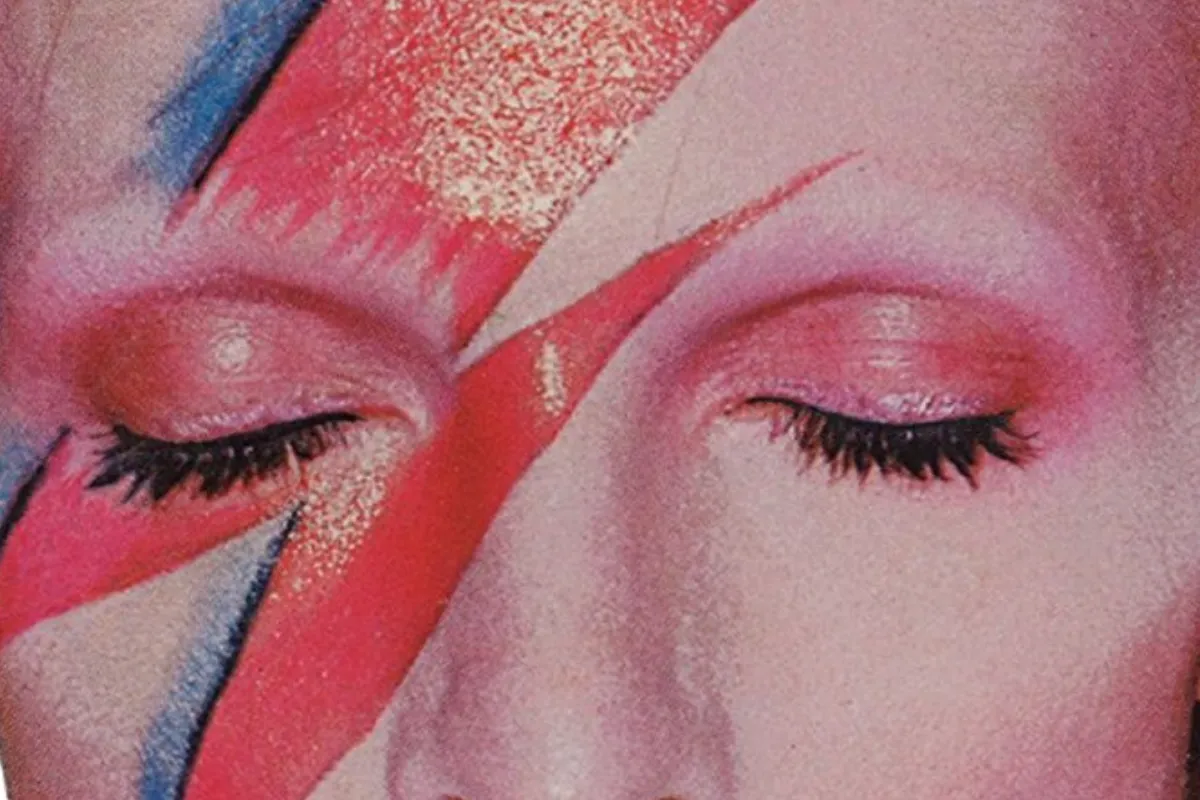
If I showed you the cover of Aladdin Sane without telling you the album title, would you know what you were looking at?
Almost certainly yes. You would know it was David Bowie. The lightning bolt across the face. The closed eyes. The porcelain skin. The calm, slightly otherworldly stillness of the whole image. You would know it was Bowie before you read a word.
But would you know the album name? Would you know it was Aladdin Sane rather than Ziggy Stardust or Heroes or any of the other Bowie records? I'm not sure I would. This is a cover so powerful that the image has completely escaped the album it was made for. It doesn't belong to Aladdin Sane anymore. It belongs to David Bowie. It belongs to everyone.
Album Anatomy
| Album | Aladdin Sane |
| Artist | David Bowie |
| Released | April 13, 1973 |
| Label | RCA Records |
| Genre | Rock |
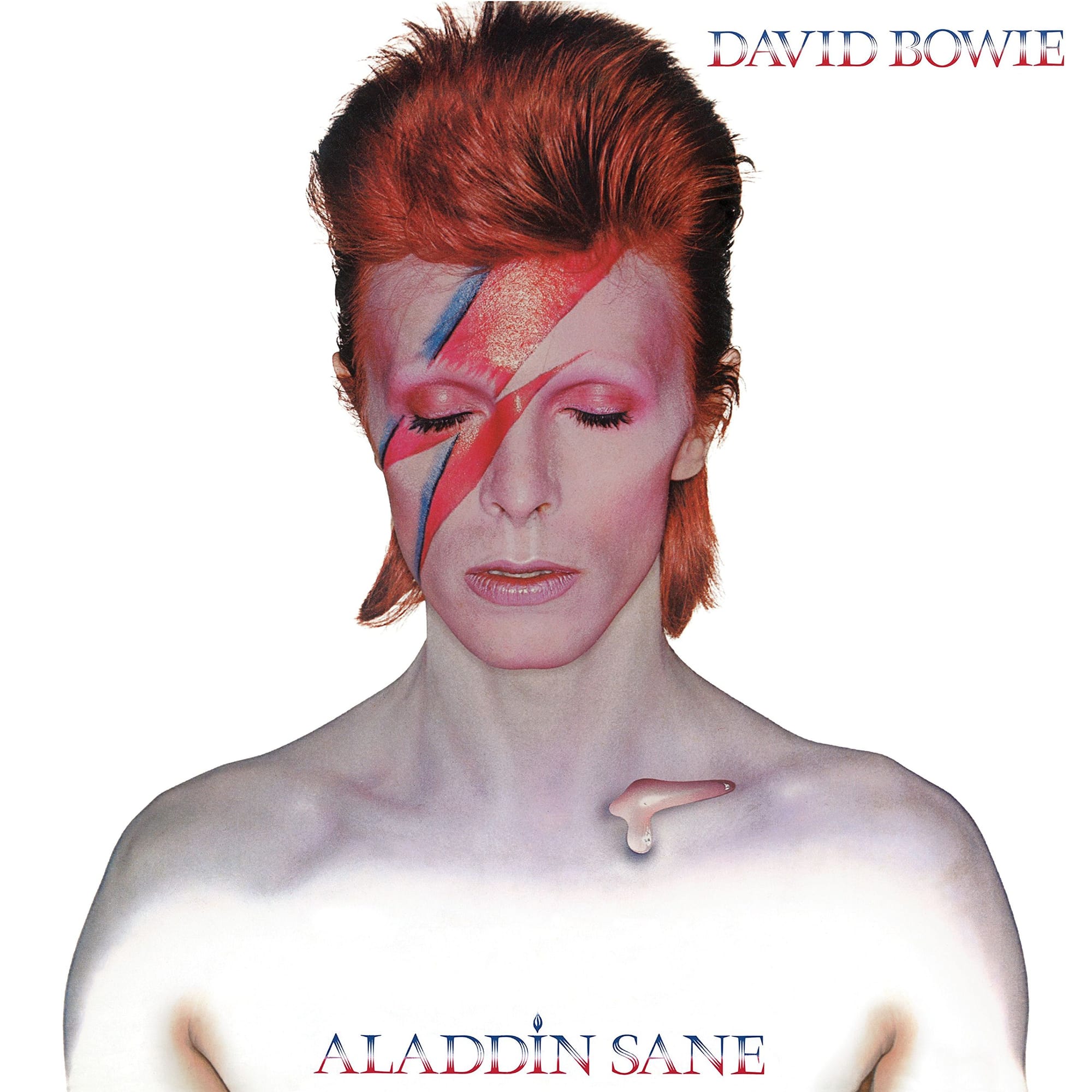
| On the cover | A close-up portrait of Bowie with a red and blue lightning bolt painted across his face, eyes closed, against a plain grey background |
| Format | Photograph, hand-retouched with airbrushed colour |
| Design | Photography by Brian Duffy, makeup by Pierre La Roche |
| Decade | 1970s |
| Buy It | Amazon |
The Manager's Gambit
January 1973. Bowie has just completed a triumphant American tour. Ziggy Stardust is a phenomenon. And his manager Tony Defries has a plan.
Defries was determined to make the cover as costly as possible, insisting on an unprecedented seven-colour printing system rather than the usual four, all in an effort to ensure RCA promoted the album extensively. The logic was elegant: the more RCA spent on the cover, the more they would need to recoup through promotion. Defries was essentially forcing the record company's hand.
The instructions to photographer Brian Duffy were simple: create a high-impact, superstar-making cover. Defries wanted to persuade RCA that Bowie was sufficiently important to warrant megastar treatment and funding.
Duffy was one of the great portrait photographers of his generation, alongside David Bailey and Terence Donovan, he had defined the visual language of swinging London in the 1960s. He was not someone you hired for a straightforward promotional shoot. He was someone you hired when you wanted something that would last.
The Rice Cooker
Now for the detail that makes this story genuinely extraordinary.
Bowie's initial idea was to have a flash, a literal lightning bolt on his face, inspired by Elvis and referencing his vision of an electric boy cracked by lightning. Pierre La Roche drew a small flash on Bowie's face, but Duffy intervened and drew a large, bold lightning bolt instead.
But where did the lightning bolt idea originally come from? The answer depends on who you ask.
According to one account, Bowie and La Roche were discussing ideas for the cover when Bowie said: "Thoughts go through my head like lightning bolts. I wish I could turn them off." Suddenly La Roche's eye fell on the Panasonic rice cooker in the studio, which had a lightning bolt on it as a caution symbol. "Shall we just paint that on your face?" That is how the idea was born.
A rice cooker. The most recognisable image in David Bowie's entire visual catalogue, the image that appeared on millions of faces on the night he died, came from a rice cooker sitting in a north London studio in January 1973.

The Teardrop
The lightning bolt gets all the attention. But look more closely at the cover and you'll notice something else, a small teardrop sitting on Bowie's collarbone.
It was added in post-production by airbrush artist Philip Castle, who had previously worked with Stanley Kubrick on the posters for A Clockwork Orange and Full Metal Jacket. Bowie thought the teardrop concept was "rather sweet" and liked the idea immediately.
The bolt splits the face. The teardrop falls from the wound.
A Lad Insane
Here is the detail that might be the best of all. The album almost had a completely different name.
According to Chris Duffy, the photographer's son, the name may have emerged from a miscommunication between Bowie and his father. "Duffy asked David what the album was to be called, and David replied, 'A Lad Insane.' Duffy interpreted this as Aladdin Sane," Chris Duffy said.
A Lad Insane. Aladdin Sane. One misheard in a studio. And the album, and the character, took its name from that mishearing.
The title was also a reference to Bowie's half-brother Terry, who had been diagnosed as a schizophrenic. Bowie feared that he, like his brother, had a split personality. The lightning bolt splitting his face in two would symbolise that division; the sane versus the insane.
The bolt is not just decoration. It is a self-portrait of a man divided against himself, rendered in red and blue across his own face.
The Most Expensive Album Cover Ever Sold
In November 2025 the original dye transfer print of the Aladdin Sane cover, shot by Duffy, airbrushed by Castle, made up by La Roche, sold at Bonhams in London for £381,400. Nearly half a million dollars. A new auction record for an album cover, breaking the previous record set by the original artwork for Led Zeppelin's debut album.
Chris Duffy, the photographer's son, took to calling the image the Mona Lisa of Pop. When Bowie died in January 2016, fans around the world painted lightning bolts on their faces in tribute. The image had long since escaped the album, escaped the music, escaped everything, and become something universal.
A rice cooker. A misheard album title. A teardrop added in post. And one of the most recognisable images in the history of popular culture.
That's the cover of Aladdin Sane.